Hugues Guillet de Chatellus, from the Institut Foton in Rennes
Title of seminar: Physics of frequency-shifting loops – Applications to sensors and signal processing
Abstract :
Frequency-shifting loops are a simple and efficient source of frequency combs. The spectral phase of these combs is quadratic and can be used to produce high repetition rate pulses through a temporal Talbot effect. Next, I will present some applications of these systems for spectroscopy and resonator characterisation. I will then show how the implementation of a double frequency-shift loop can be used to produce a dual-comb, thereby extending the applications of these architectures to coherent lidar and distributed acoustic sensors. Finally, I will present two applications of double frequency-shift loops for microwave photonics: real-time signal correlation and spectral analysis of broadband signals.
14 Nov 2025
11h00
Raphael Lopes, from LKB College de France
Title of seminar: Two-Body Contact Dynamics in a Bose Gas near a Fano-Feshbach Resonance
Abstract :
We investigate the real-time buildup of short-range correlations in a nondegenerate ultracold Bose gas near a narrow Fano-Feshbach resonance. Using rapid optical control, we quench the closed-channel molecular energy to resonance on sub-microsecond timescales and track the evolution of the two-body contact through photo-dissociation losses. Repeated pulse sequences enhance sensitivity to early-time two-body losses and reveal long-lived coherence between atom pairs and molecular states. The observed dynamics are accurately reproduced by our dynamical two-channel zero-range theory, which explicitly accounts for the resonance’s narrow width and finite closed-channel decay, establishing a predictive framework for correlation dynamics in quantum gases near Fano-Feshbach resonances.
17 Oct 2025
11h00
Nami Sakai, from the RIKEN institute in Saitama, Japan
Title of seminar: A Radio Astronomy-Based Spectrometer for Isotopologue Studies of Interstellar Molecules
Abstract :
Recent observations with ultra-sensitive radio telescopes, such as ALMA, have revealed that protostellar gas is rich in complex organic molecules (COMs). Many are thought to form on ices and then sublimate, but distinguishing ice-formed from gas-phase species remains a central question. Addressing this requires high-sensitivity observations supported by spectroscopic data that enable us to derive accurate isotopic ratios of individual molecular species in astronomical sources. However, such data are still lacking for rare isotopologues and highly excited states, posing a major limitation for interpreting astronomical observations.
To overcome this, we developed SUMIRE, an emission-type molecular spectrometer based on radio astronomy receiver technology. SUMIRE covers most of the main ALMA frequency ranges, Band 6 (211–275 GHz) and Band 7 (275–373 GHz), and allows simultaneous wide-band measurements up to 24 GHz. Its key innovation is a calibration system equivalent to that of radio astronomy, enabling direct comparison of laboratory and astronomical spectra. With purified isotopologue samples, SUMIRE also provides absolute intensity calibration values.
We are currently using SUMIRE to obtain spectra of deuterated and 13C-substituted methanol isotopologues, the most abundant saturated organic molecule in interstellar clouds, and applying them to astronomical data analysis. In this seminar, I will present these results, highlight the role of spectroscopy in astrochemistry, and also give an overview of the current situation of astrochemical research in Japan.
3 Oct 2025
11h00
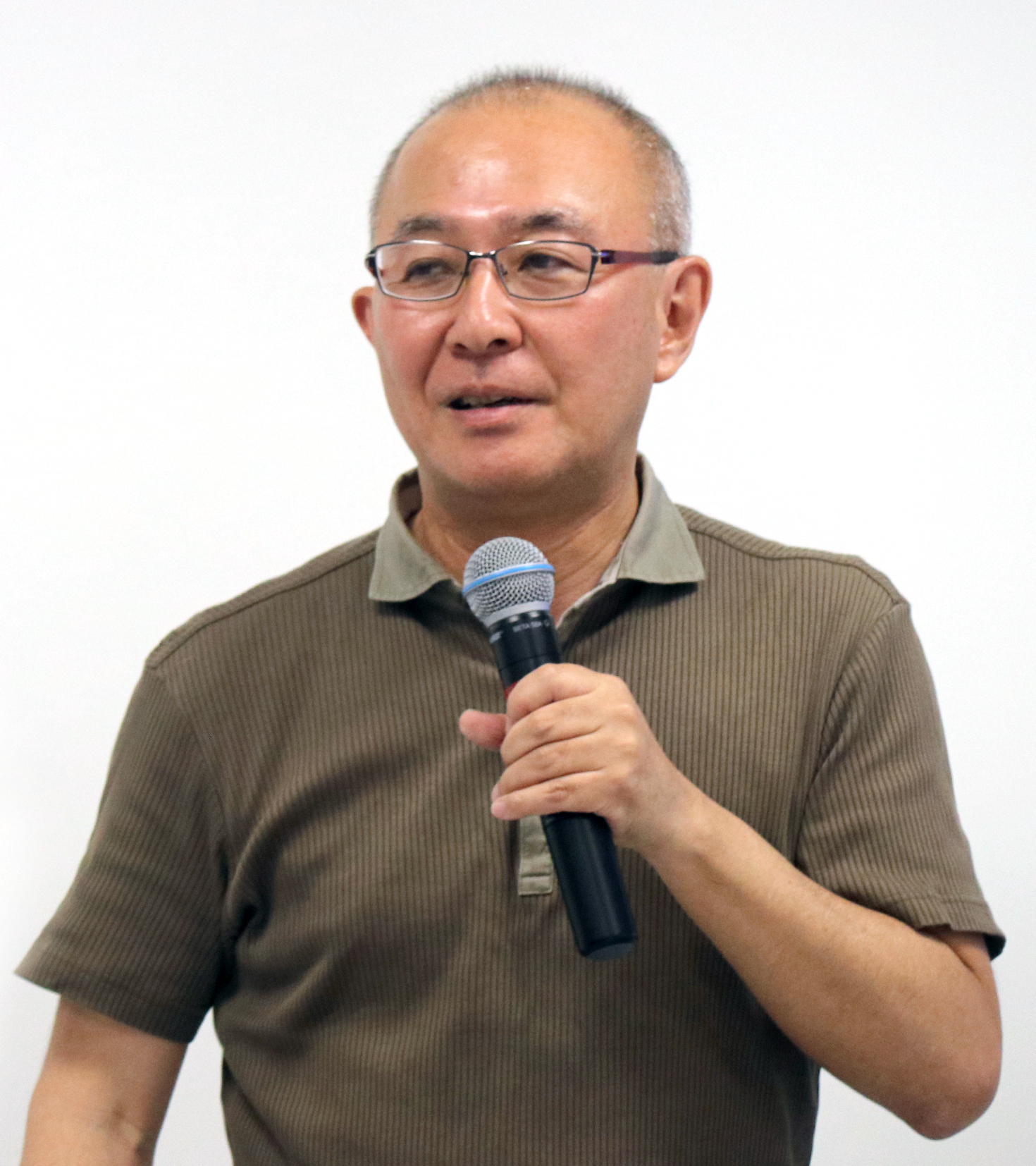
Makoto Tsubota – Osaka Metropolitan University, Osaka, Japan
Vortices in liquid He, energy spectrum of quantum turbulence, quantum turbulence in atomic BECs
Following last week’s seminar, I will talk about quantum hydrodynamics and turbulence [1]. I will discuss important issues by referring to both superfluid helium and atomic BECs.
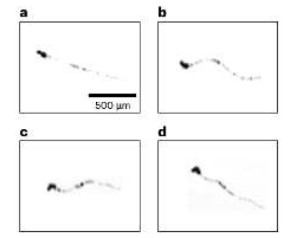
1.Visualization of quantized vortices in superfluid 4He: A major recent development in the field of superfluid helium has been brought about by visualization experiments. The group led by Lathrop succeeded in visualizing quantized vortices using solid hydrogen particles [2], and subsequently in observing their reconnections. Minowa et al. employed silicon particles generated by laser ablation to achieve the direct excitation of Kelvin waves and to observe their three-dimensional helical structure [3]. Furthermore, through measurements of the chirality and propagation direction of Kelvin waves, they succeeded for the first time in identifying the orientation of vorticity in quantized vortices.
Fig.1 Observed Kelvin waves
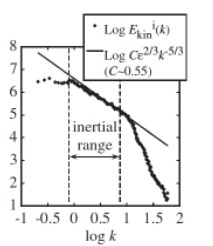
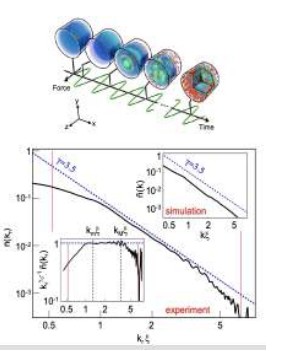
Energy spectrum of quantum turbulence Turbulence is not merely a disordered arrangement of vortices; rather, the confirmation of statistical laws such as the Kolmogorov law provides crucial evidence. The energy spectrum of quantum turbulence (QT) within the Gross–Pitaevskii (GP) equation framework was first investigated by Brachet and collaborators. As in the case of atomic BECs, the GP equation describes a compressible fluid, and thus the energy spectrum must be decomposed into an incompressible component due to quantized vortices and a compressible component due to phonons. Starting from a Taylor–Green vortex, they studied decaying QT and demonstrated that the incompressible spectrum exhibits a −5/3 scaling during the decay process [4]. Subsequently, Kobayashi and Tsubota introduced large-scale forcing and small-scale dissipation into the GP equation to generate steady-state QT, and confirmed that the incompressible spectrum follows the −5/3 law in this regime [5].
Fig.2 Energy spectrum of QT by the GP model
. Quantum turbulence in atomic BECs Because an atomic BEC is a finite system confined by a trapping potential, QT cannot be generated simply by driving flow as in superfluid 4He. Instead, several methods have been proposed to create QT, including manipulations of the trapping potential. Kobayashi and Tsubota demonstrated that biaxial rotation of a BEC can induce turbulence [6], and, building on this idea, Bagnato et al. succeeded in realizing and observing three-dimensional QT through controlled modifications of the trapping potential [7]. Two-dimensional QT has also been realized [8]. However, these remain finite trapped systems with only a limited number of vortices. For turbulence, the verification of statistical laws is desirable, but such observations were hampered by the nonuniform density of the trapped gas. Recently, however, Navon et al. created turbulence in a BEC confined by a box potential, succeeded in demonstrating a power-law density spectrum [9], and observed a cascade of excitations flowing from low to high wave numbers [10].
Fig.3 QT in a box potential
[1] M. Tsubota, K. Kasamatsu, Quantum Hydrodynamics and Turbulence (Oxford Univ. Press) (2025). [2] G. P. Bewley et al. Nature 441, 588(2006). [3] Y. Minowa, Y. Yasui, T. Nakagawa, S. Inui, MT, M. Ashida, Nat. Phys. 233, 21(2025). [4] C. Nore, M. Abid, and M. E. Brachet, Phys. Rev. Lett. 78,3896 (1997); Phys. Fluids 9, 2644 (1997). [5] M. Kobayashi, MT, Phys. Rev. Lett. 94, 065302(2005); J. Phys. Soc. Jpn. 74, 3248(2005). [6] M. Kobayashi, MT, Phys. Rev. A76, 045603(2007). [7] E. A. L. Henn et al. , Phys. Rev. Lett. 103, 045301 (2009). [8] K. E. Wilson et al., Annu. Rev. Cold At. Mol. 1, 261 (2013) : W. J. Kwon et al., Phys. Rev. A 90, 063627 (2014). [9] N. Navon, A. L. Gaunt, R. P. Smith, Z. Hadzibabic, Nature 539, 72 (2016) [10] N. Navon, C. Eigen, J. Zhang, R. Lopes, A. L. Gaunt, K. Fujimoto, MT, R. P. Smith, Z. Hadzibabic, Science 366, 382 (2019)
26 Sep 2025
11h00
Makoto Tsubota – Osaka Metropolitan University, Osaka, Japan
Quantum hydrodynamics and turbulence [1] have long been studied in superfluid helium since the 1950s, as well as in atomic Bose-Einstein condensates (BECs) since 1995. In this two-part seminar series, I will present this topic in an accessible way.
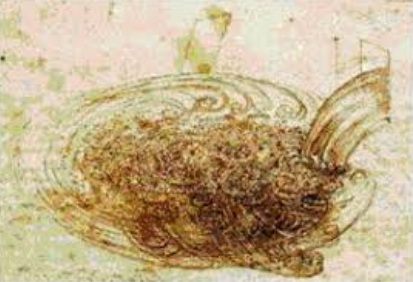
Classical turbulence: Turbulence is an important problem in both fundamental science and engineering [2,3]. It is a strongly nonlinear and non-equilibrium phenomenon, and therefore very challenging. About 500 years ago, Da Vinci sketched Fig. 1, illustrating the Richardson cascade, in which large vortices break down into smaller ones. However, vortices in classical viscous fluids are unstable and not uniquely defined, so confirming this picture is not straightforward. Another important perspective on turbulence is its statistical laws. The most important statistical law of fully developed turbulence is Kolmogorov’s −5/3 law of the energy spectrum, which has been confirmed by many experiments and numerical simulations.
Fig.1 Sketch of turbulence by Da Vinci.
Quantum hydrodynamics: In parallel with such studies in fluid dynamics, research on the superfluidity of liquid helium has progressed in the field of low-temperature physics. This system is characterized by the Bose–Einstein condensation of 4He atoms. Many of its distinctive phenomena are explained by the two-fluid model, which describes the system as consisting of an inviscid superfluid and a viscous normal fluid, with their relative fractions determined by temperature. Moreover, vortices in the superfluid become quantized vortices with discrete circulation, which have become a defining hallmark of the quantum hydrodynamics of this system. Turbulence generated by such quantized vortices is referred to as quantum turbulence. The typical platforms for quantum hydrodynamics are superfluid helium and atomic BECs. In the strongly correlated Bose system of superfluid 4He, the vortex filament model is employed. In contrast, for atomic BECs, the Gross–Pitaevskii (GP) equation provides a quantitatively accurate description.
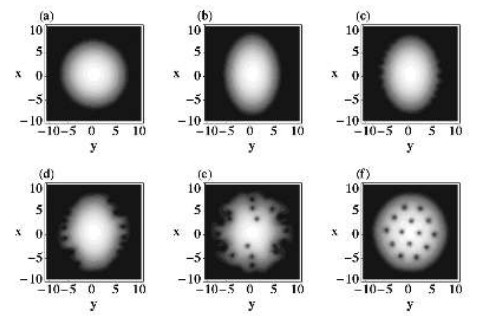
Formation of a lattice of quantized vortices in rotating BECs One of the central problems in quantum hydrodynamics is the formation of a quantized vortex lattice in a rotating BEC. In the case of a classical viscous fluid, when the container is rotated, the fluid undergoes rigid-body rotation with the same rotation frequency as the container. However, due to the quantization of circulation, a quantum fluid does not behave in this way. Instead, a number of quantized vortices proportional to the rotation frequency penetrate into the condensate, forming a triangular lattice, thereby realizing rigid-body rotation of the superfluid. This phenomenon had already been known in superfluid helium, but the dynamics leading to it were observed by the experimental group at ENS [4]. A BEC confined in a harmonic trapping potential first undergoes quadrupole oscillations, after which its surface becomes unstable, allowing quantized vortices to enter. Ultimately, a triangular lattice is formed. Such behavior has been confirmed by numerical simulations of the GP equation [5].
Fig.2 Vortex lattice formation in a rotating BEC.
[1] M. Tsubota, K. Kasamatsu, Quantum Hydrodynamics and Turbulence (Oxford Univ. Press) 2025. [2] U. Frisch, Turbulence: The Legacy of A. N. Kolmogorov (Cambridge University Press) 1995. [3] P. A. Davidson, Turbulence: An Introduction for Scientists and Engineers (Oxford University Press) 2015. [4] K. W. Madison et al., Phys. Rev. Lett. 86, 4443 (2001). [5] MT, K. Kasamatsu, M. Ueda, Phys. Rev. A65, 23603(2002): K. Kasamatsu, MT, M. Ueda, Phys. Rev. A67,33610(2003)
12 Sep 2025
11h00
Francesco Intravaia, from the Humboldt University of Berlin
Title of seminar: Quantum Fluctuation Forces Near Material Interfaces
Abstract:
Fluctuations are ubiquitous in classical and quantum physics, affecting various disciplines like biophysics, gravity, chemistry, and cosmology. In recent years, the pursuit of miniaturization has led to a surge in interest in electromagnetic quantum fluctuation-induced interactions, both for fundamental and technological reasons. Despite often being imperceptible at the macroscopic scale, these interactions can indeed be rather significant in microscopic systems, presenting challenges as well as opportunities for quantum technologies. Paradigmatic examples include van der Waals and Casimir forces, which can be beneficial or disruptive in device design. Recent advancements have enabled exploration of nonequilibrium physics, quantum electrodynamics, atomic, and condensed matter physics as well as their interfacing within this research domain. Understanding these forces provides novel perspectives on the underlying physics and paves the way for future developments.
Pour offrir les meilleures expériences, nous utilisons des technologies telles que les cookies pour stocker et/ou accéder aux informations des appareils. Le fait de consentir à ces technologies nous permettra de traiter des données telles que le comportement de navigation ou les ID uniques sur ce site. Le fait de ne pas consentir ou de retirer son consentement peut avoir un effet négatif sur certaines caractéristiques et fonctions.
Fonctionnel
Always active
Le stockage ou l’accès technique est strictement nécessaire dans la finalité d’intérêt légitime de permettre l’utilisation d’un service spécifique explicitement demandé par l’abonné ou l’utilisateur, ou dans le seul but d’effectuer la transmission d’une communication sur un réseau de communications électroniques.
Préférences
Le stockage ou l’accès technique est nécessaire dans la finalité d’intérêt légitime de stocker des préférences qui ne sont pas demandées par l’abonné ou l’utilisateur.
Statistiques
Le stockage ou l’accès technique qui est utilisé exclusivement à des fins statistiques.Le stockage ou l’accès technique qui est utilisé exclusivement dans des finalités statistiques anonymes. En l’absence d’une assignation à comparaître, d’une conformité volontaire de la part de votre fournisseur d’accès à internet ou d’enregistrements supplémentaires provenant d’une tierce partie, les informations stockées ou extraites à cette seule fin ne peuvent généralement pas être utilisées pour vous identifier.
Marketing
Le stockage ou l’accès technique est nécessaire pour créer des profils d’utilisateurs afin d’envoyer des publicités, ou pour suivre l’utilisateur sur un site web ou sur plusieurs sites web ayant des finalités marketing similaires.