Laurent Labonte, from the Institut de Physique de Nice
Title of seminar: Quantum logic control of molecular and transition-metal ions
Abstract:
Quantum metrology exploits uniquely quantum properties such as entanglement and quantum interference to improve the precision of measurements beyond what is achievable with classical resources. While quantum-enhanced sensing has demonstrated remarkable performances in laboratory environments, transferring these advantages to practical fiber-based platforms remains a significant challenge due to optical losses and experimental imperfections.
In this seminar, I will present our recent work on quantum interferometric metrology using entangled photons in telecom optical fibers. After introducing the concepts of quantum advantage and a Fisher information framework for realistic quantum sensing, I will present the experimental demonstration of quantum-enhanced phase sensing in an all-fiber Mach–Zehnder interferometer. These results illustrate the potential of fiber-integrated quantum photonics for practical quantum sensing. Then, I will introduce our recent work on quantum-enhanced phase tracking through spectral noise reduction and finally discuss how quantum communication techniques, including QKD-based synchronization, can be leveraged to enable long-distance quantum sensor networks.
The seminar will illustrate how quantum photonic technologies are progressively moving from proof-of-principle demonstrations toward practical quantum sensing systems compatible with existing telecommunication infrastructures.
2 Juil 2026
11h00
Fabian Wolf, QUEST Institut, PTB Braunschweig
Title of seminar: Quantum logic control of molecular and transition-metal ions
Abstract:
Extending quantum control to increasingly complex systems is essential for advancing quantum technologies and probing fundamental physics. Molecules, in particular, serve as highly sensitive systems for detecting symmetry violations that may reveal physics beyond the Standard Model. However, their complex level structure makes quantum-state control challenging.
Quantum logic spectroscopy offers a promising path forward for molecular ions: a well-controlled atomic ion is co-trapped with a molecular ion and enables manipulation and readout of its quantum state via shared motional modes. I will present an overview of our latest results and concepts in quantum logic control of molecular ions. As we progress toward quantum logic spectroscopy of single molecular MgH⁺ ions, we are also assessing the broader applicability of these techniques to other ionic species. Recently, we demonstrated quantum logic control of a single titanium ion [1,2], showing that these methods can be extended to previously inaccessible atomic systems.
By enhancing control over new classes of ions, our work opens the door to novel applications in quantum technology and fundamental physics, making an extended range of species available for precision spectroscopy.
References:
[1] Rehmert et al. Quantum Logic Control of a Transition Metal Ion, Physical Review Letters 134, 113201 (2025)
[2] Rehmert et al. Landé g Factor Measurement of 48Ti+ Using Simultaneous Comagnetometry and Quantum Logic Spectroscopy, Physical Review Letters 136, 083203 (2026)
12 Juin 2026
11h00
Fabrice Wiotte, du Laboratoire de Physique des Lasers (LPL) à l’Université Sorbonne Paris Nord
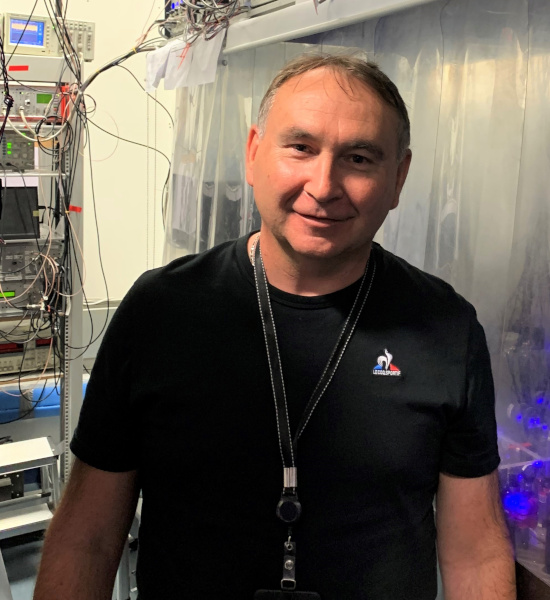
Titre du séminaire: Développement de projet d’électronique numérique sur cartes FPGA grâce à l’écosystème PYNQ et aux notebooks Jupyter
Résumé :
Cette présentation illustrera concrètement comment Python permet de simplifier la programmation matérielle et l’instrumentation scientifique, à travers des cas d’usage sur trois cartes : Eclypse Z7, Red Pitaya 125-14 et RFSoC 4×2.
5 Juin 2026
11h00
Sandrine Galtier, from the Institut Lumière Matière (ILM) in Lyon
Title of seminar: UV-Dual Comb Spectroscopy using a bidirectional mode-locked femtosecond Ti:Sapphire ring laser
Abstract :
The development of broadband, precise, and rapid molecular spectroscopy addresses current challenges in gas detection within dynamic and complex environments. I will present dual-comb spectroscopy, a technique that is particularly well suited to meeting these challenges. At the Institute of Light and Matter (Lyon), we are developing dual-comb spectroscopy in the UV spectral range to probe highly reactive species such as radicals. I will introduce the experimental dual-comb source we have developed, based on a mode-locked femtosecond Ti ring laser, discuss its unique characteristics and present spectroscopic results obtained in both the IR and UV spectral regions.
22 Mai 2026
11h00
Clara Zyskind from the PTB institute in Braunschweig, Germany
Title of seminar: Tests of fundamental physics using ytterbium ions
Abstract :
I will present the first results from my postdoc at PTB in Braunschweig, Germany. Trapped ions are widely used in optical clocks and fundamental physics. Among them, the forbidden electric octupole (E3) transition in 173Yb⁺ offers key advantages, including an extremely narrow natural linewidth and high sensitivity to physics beyond the Standard Model. The large electric quadrupole moment of its deformed nucleus is predicted to enhance this forbidden transition. I will show how we confirmed this effect and observed hyperfine-state-dependent quenching, paving the way toward multi-ion clocks using 173Yb⁺. I will further show how the rich hyperfine structure can be used to probe the nuclear properties of 173Yb⁺, making it a particularly promising candidate for searches of a fifth force using isotope shifts measurements and King plot analysis.
10 Avr 2026
10h00
Raphaël Hahn du LPL dans l’équipe MMT à l’Université Sorbonne Paris Nord
Title of seminar: (Cold) Molecules as a tool to probe fundamental physics
Abstract:
Modern physics is struck with a paradox: there are very good reasons to believe that our current understanding of Nature is incomplete, yet it is exceedingly difficult to conduct an experiment which contradicts our best theories. This tension is particularly palpable since the Large Hadron Collider explored a wide range of energies without a clear detection of new physics, thereby discarding many extensions Beyond the Standard Model (BSM). Searching for new physics in the high energy domain now demands extremely large investments to build bigger and brighter instruments. Another approach, complementary but very powerful, is to perform small scale, low-energy experiments but with very high precision1. In the last 20 years in particular, this led the community to look for new physics in much larger objects than elementary particle: molecules. Many proposals and experiments have demonstrated the potential of molecules to test our fundamental understanding of Nature: from probing variations of fundamental constants like the electron mass over the proton mass or the fine-structure constant , or different models for dark matter, to testing the symmetrisation postulate of Quantum Mechanics or Bose-Einstein statistics. Especially notable are experiments currently responsible for the most stringent limit on the value of the electron electric dipole moment (which constraints strongly potential BSM theories).
However, the field is still in its infancy: the molecules that are currently used to explore new physics are composed of 2, 3 or 4 atoms at most, even though larger molecules offer qualitatively distinct opportunities in fundamental physics. The abundance of nearly degenerate rovibrational levels in the larger, polyatomic molecules (with more than 10 atoms) enhances their sensitivity to variations of fundamental constants or to potential ultralight bosonic dark matter. They can also provide a new system for implementing quantum computing, using either rotational or vibrational levels, and taking advantage of robust systematic error rejection schemes. Having more than 3 atoms also opens up the possibility to use molecular chirality to probe parity-violating interactions. Indeed, the energy levels of two enantiomers (the mirror-images of chiral molecules) are predicted to be slightly different, because of the parity-violation inherent to the weak interaction, or as a result of their interaction with dark-matter fields. Thus, a measurement of this symmetry-breaking energy difference ΔEPV is a sensitive probe of the Standard Model and of physics BSM.
However, as the number of atoms in a molecule goes up, the number of energy levels increases very rapidly, as well as the couplings between these energy levels. These couplings limit the applicability of the usual cooling mechanisms because they induce population losses towards many different states. Couplings between different vibrational modes (denoted in the literature as Intramolecular Vibrational Redistribution (IVR)) also blur out spectroscopic resolution by what can be viewed as a loss of coherence due to non-radiative dynamic energy distribution in the molecule.
In this talk I will review the current use, the potential ahead and the obstacles on the way of using molecules for tests of fundamental physics, focussing on our on-going attempt to measure ΔEPV in chiral molecules at the Laboratoire de Physique des Lasers.
Pour offrir les meilleures expériences, nous utilisons des technologies telles que les cookies pour stocker et/ou accéder aux informations des appareils. Le fait de consentir à ces technologies nous permettra de traiter des données telles que le comportement de navigation ou les ID uniques sur ce site. Le fait de ne pas consentir ou de retirer son consentement peut avoir un effet négatif sur certaines caractéristiques et fonctions.
Fonctionnel
Toujours activé
Le stockage ou l’accès technique est strictement nécessaire dans la finalité d’intérêt légitime de permettre l’utilisation d’un service spécifique explicitement demandé par l’abonné ou l’utilisateur, ou dans le seul but d’effectuer la transmission d’une communication sur un réseau de communications électroniques.
Préférences
Le stockage ou l’accès technique est nécessaire dans la finalité d’intérêt légitime de stocker des préférences qui ne sont pas demandées par l’abonné ou l’utilisateur.
Statistiques
Le stockage ou l’accès technique qui est utilisé exclusivement à des fins statistiques.Le stockage ou l’accès technique qui est utilisé exclusivement dans des finalités statistiques anonymes. En l’absence d’une assignation à comparaître, d’une conformité volontaire de la part de votre fournisseur d’accès à internet ou d’enregistrements supplémentaires provenant d’une tierce partie, les informations stockées ou extraites à cette seule fin ne peuvent généralement pas être utilisées pour vous identifier.
Marketing
Le stockage ou l’accès technique est nécessaire pour créer des profils d’utilisateurs afin d’envoyer des publicités, ou pour suivre l’utilisateur sur un site web ou sur plusieurs sites web ayant des finalités marketing similaires.