


Title of seminar: An optical lattice clock with a bosonic isotope of mercury
Abstract:
Among other neutral species, mercury has interesting properties for an optical lattice clock such as a low sensitivity to blackbody radiation (16 times lower than Yb, 30 times lower than Sr) and a
high vapour pressure at room temperature. So far, the 199Hg fermionic isotope was the only isotope used in a mercury clock, but its limited lifetime in the excited state will prevent to fully exploit the
new generation of ultrastable lasers to come. Using bosonic isotopes instead is a way to bypass this limit thanks to a potentially unlimited lifetime.
We report the first observation of the 198Hg bosonic transition in an optical lattice clock, which results from several key experimental developments and a challenging search of a narrow transition in a wide uncertainty span.
The bosonic clock transition is forbidden and needs to be induced thanks to a high magnetic field. This is the so called quenching method1. It allows longer probing times, adjustable to the laser properties. Hence, a first key step was developing a setup to produce a large enough magnetic field to induce the bosonic transition with the highest coupling achievable. Another challenge was implementing a widely tunable and flexible probe laser while maintaining the ultra-low noise properties, in order to probe any of the mercury isotopes with no additional noise. The coupling is also increasing with the probe power, so a major step was to significantly increase our deep UV ultrastable light power.
Given all these experimental advances, we calculated that we still had a relatively weak coupling and hence a narrow line transition to be found in a large frequency span. We performed various measurements and checks thanks to the 199Hg isotope, especially a substantial alignment work, to optimize our chances to find the transition. Thanks to cumulated efforts, the search of the 198Hg transition was a success, making it the first observation of a mercury bosonic isotope transition.
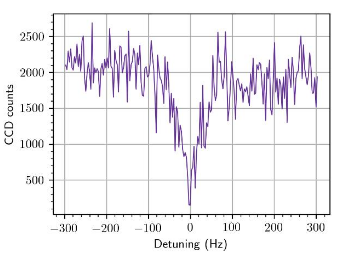
We further obtained an operational optical lattice clock with the bosonic 198Hg, already reaching a stability of 10-15 at 1 second. We have undertaken several studies of this new transition, in particular we measured the quadratic Zeeman shift coefficient with an uncertainty suitable to control this shift to 10-17 or better. We also started studying other systematic effects such as the probe light shift and measuring the magic wavelength. Finally, we are working towards measuring, for the first time, the 198Hg/87Sr optical frequency ratio.
- 1 A. V. Taichenachev et al., “Magnetic Field-Induced Spectroscopy of Forbidden Optical Transitions with Application
to Lattice-Based Optical Atomic Clocks”, Phys. Rev. Lett., vol. 96(8), p.083001, 2006.