

Classical turbulence, quantum hydrodynamics, vortex lattices in rotating Bose-Einstein condensates (BECs)
Quantum hydrodynamics and turbulence [1] have long been studied in superfluid helium since the 1950s, as well as in atomic Bose-Einstein condensates (BECs) since 1995. In this two-part seminar series, I will present this topic in an accessible way.
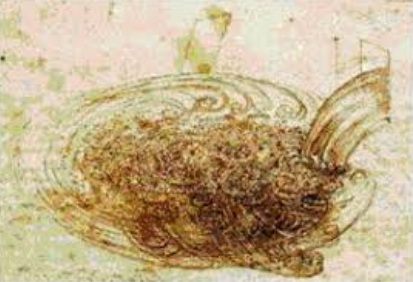
- Classical turbulence: Turbulence is an important problem in both fundamental science and engineering [2,3]. It is a strongly nonlinear and non-equilibrium phenomenon, and therefore very challenging. About 500 years ago, Da Vinci sketched Fig. 1, illustrating the Richardson cascade, in which large vortices break down into smaller ones. However, vortices in classical viscous fluids are unstable and not uniquely defined, so confirming this picture is not straightforward. Another important perspective on turbulence is its statistical laws. The most important statistical law of fully developed turbulence is Kolmogorov’s −5/3 law of the energy spectrum, which has been confirmed by many experiments and numerical simulations.
- Quantum hydrodynamics: In parallel with such studies in fluid dynamics, research on the superfluidity of liquid helium has progressed in the field of low-temperature physics. This system is characterized by the Bose–Einstein condensation of 4He atoms. Many of its distinctive
phenomena are explained by the two-fluid model, which describes the system as consisting of an inviscid superfluid and a viscous normal fluid, with their relative fractions determined by temperature. Moreover, vortices in the superfluid become quantized vortices with discrete circulation, which have become a defining hallmark of the quantum hydrodynamics of this system.
Turbulence generated by such quantized vortices is referred to as quantum turbulence. The typical platforms for quantum hydrodynamics are superfluid helium and atomic BECs. In the strongly correlated Bose system of superfluid 4He, the vortex filament model is employed. In contrast, for atomic BECs, the Gross–Pitaevskii (GP) equation provides a quantitatively accurate description.
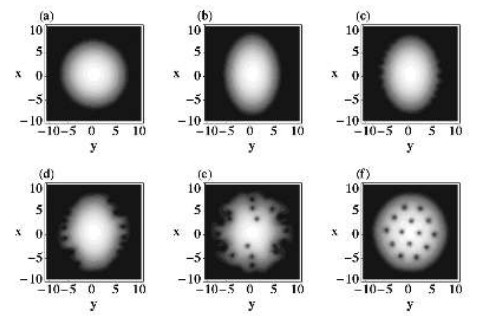
- Formation of a lattice of quantized vortices in rotating BECs One of the central problems in quantum hydrodynamics is the formation of a quantized vortex lattice in a rotating BEC. In the case of a classical viscous fluid, when the container is rotated, the fluid undergoes rigid-body rotation with the same rotation frequency as the container. However, due to the quantization of circulation, a quantum fluid does not behave in this way. Instead, a number of quantized vortices proportional to the rotation frequency penetrate into the condensate, forming a triangular lattice, thereby realizing rigid-body rotation of the superfluid. This phenomenon had already been known in superfluid helium, but the dynamics leading to it were observed by the experimental group at ENS [4]. A BEC confined in a harmonic trapping potential first
undergoes quadrupole oscillations, after which its surface becomes unstable, allowing quantized vortices to enter. Ultimately, a triangular lattice is formed. Such behavior has been confirmed by numerical simulations of the GP equation [5].
[1] M. Tsubota, K. Kasamatsu, Quantum Hydrodynamics and Turbulence (Oxford Univ. Press) 2025.
[2] U. Frisch, Turbulence: The Legacy of A. N. Kolmogorov (Cambridge University Press) 1995.
[3] P. A. Davidson, Turbulence: An Introduction for Scientists and Engineers (Oxford University Press) 2015.
[4] K. W. Madison et al., Phys. Rev. Lett. 86, 4443 (2001).
[5] MT, K. Kasamatsu, M. Ueda, Phys. Rev. A65, 23603(2002): K. Kasamatsu, MT, M. Ueda, Phys. Rev. A67,33610(2003)